Solar Battery Storage Costs in Germany (2026): How Much Does It Cost and When Does It Pay for Itself?
There's a moment most solar panel owners experience — usually sometime in the first winter after installation. The days are short, the sun is weak, and the electricity bill is... not quite what they imagined it would be.
The reason is not complicated. Without storage, most households only consume a fraction of the solar energy they generate. The rest is exported to the grid during the day and later repurchased at higher retail electricity rates in the evening.
This mismatch between production and consumption is the central economic limitation of PV systems without storage.
Battery storage systems solve this problem by shifting solar energy from midday to evening usage, increasing self-consumption and reducing reliance on the grid.
But how much does a battery storage system cost in Germany in 2026? What subsidies and financing options are still available? And how long does it typically take for the investment to pay for itself?
This guide answers the most important questions homeowners should consider before investing in solar battery storage system.
Why Are More German Homeowners Adding Battery Storage to Their Solar Systems?
The rapid growth of Germany’s residential battery storage market is not simply the result of falling battery prices. For most homeowners, the primary motivation is much more practical: they want to use more of the solar electricity they generate themselves.
Without battery storage system, a typical household can directly consume only around 30% to 40% of its solar production. The remaining electricity is exported to the grid under the Renewable Energy Sources Act (EEG). Later, when solar production declines and household demand rises, electricity must be purchased back from the utility provider.
Battery storage fundamentally changes this relationship.
Instead of exporting excess electricity immediately, the system stores it for later use. When the sun goes down, stored solar energy can continue supplying the home before any electricity is drawn from the grid.
Research from HTW Berlin puts numbers on what this shift looks like in practice. With a well-sized battery system, solar self-consumption rates can jump from approximately 30–40% to as much as 60–80%. At the same time, household energy self-sufficiency can increase from around 30% to roughly 70%.
The benefits become even more significant for households that operate heat pumps or electric vehicles. Through intelligent energy management system, excess solar generation can be redirected toward heating and mobility, allowing homeowners to reduce energy costs while maximising the value of every kilowatt-hour produced on their roof.
Beyond the financial benefits, many homeowners also value the greater degree of energy independence that battery storage system provides. As electricity prices continue to fluctuate, the ability to generate, store and use your own energy becomes increasingly attractive.
How Much Does a Home Battery Storage System Cost in Germany in 2026?
Home battery storage system prices have become considerably more attractive over the past several years as manufacturing volumes have increased and lithium iron phosphate (LFP) technology has matured.
In 2026, the average installed cost of a residential battery storage system in Germany, including the battery, inverter, energy management system and installation, typically ranges between €550 and €1,200 per usable kWh of storage capacity. For a typical 10 kWh residential storage system, homeowners can generally expect a total investment of approximately €5,500 to €11,500.
However, battery storage capacity alone does not determine the final project cost.
Several factors influence pricing, including battery technology, backup power functionality, inverter specifications, installation complexity, warranty coverage and overall system design.
For example, systems equipped with emergency backup power (Notstrom) capabilities often require additional hardware and therefore involve higher investment costs. Premium systems that integrate advanced energy management features may also command a higher upfront price but deliver stronger long-term economic performance.
For this reason, comparing battery storage systems solely based on capacity or purchase price rarely tells the whole story. Homeowners should evaluate the overall system architecture, efficiency, durability and expected lifetime savings when assessing value.
What Solar Battery Storage System Subsidies and Incentives Are Available in Germany in 2026?
One of the most common misconceptions among homeowners is that Germany has largely phased out support for residential solar and battery storage investments.
In reality, government support remains available, although the structure has changed significantly in recent years.
Instead of relying primarily on direct grants, Germany increasingly supports renewable energy investments through tax incentives, financing programmes and long-term revenue mechanisms.
For most homeowners, the two most important nationwide incentives are the 0% VAT scheme and the EEG feed-in tariff.
Since 2023, residential photovoltaic systems up to 30 kWp, including associated battery storage systems, have qualified for a 0% VAT rate on supply and installation.
Compared with the previous standard VAT rate of 19%, this represents a significant reduction in project costs. For a battery storage system worth €10,000 at LumenHaus, the VAT exemption alone can reduce investment costs by approximately €1,900.
At the same time, solar systems installed before future regulatory changes continue to benefit from long-term EEG feed-in remuneration. Even if a household cannot consume all of its solar production, surplus electricity can still generate predictable income through grid exports.
Because these incentives are available regardless of income level, require no application process and are not limited by annual funding budgets, many industry experts refer to them as Germany’s “subsidy floor” for residential solar investments.
How Do KfW 270, 0% VAT and EEG Feed-in Tariffs Improve Battery Storage System ROI?
When calculating the ROI of a battery storage system, focusing solely on the equipment price can be misleading.
The true economics of a project depend on the interaction between installation costs, financing conditions, tax incentives and future energy savings.
One of the most important financing tools available to homeowners remains the KfW 270 Renewable Energy Programme. This programme provides favourable financing conditions for investments in photovoltaic systems, battery storage and associated installation costs.
For many households, low-interest financing can significantly reduce the upfront financial burden and make a larger energy project more accessible.
In addition to federal incentives, some German states continue to offer regional support programmes.
Bavaria, for example, has discontinued its broad PV subsidy programmes but continues to support residential battery storage through the 10,000 Houses Programme. Eligible homeowners may receive grants of up to €3,200 depending on system specifications.
Hesse follows a different strategy. Rather than offering direct grants, the state supports renewable energy investments through favourable financing programmes administered by WiBank.
As a result, the financial attractiveness of battery storage system can vary considerably depending on location. Before making an investment decision, homeowners should evaluate all available incentives, financing options and local programmes rather than focusing exclusively on equipment costs.
What Makes a Smart Home Battery Storage System Different?
Battery storage system technology has evolved far beyond simply storing electricity.
Modern systems increasingly combine storage hardware with intelligent software designed to optimise how and when energy is used. As dynamic electricity tariffs become more common and household energy systems become more complex, smart energy management is becoming a key differentiator.
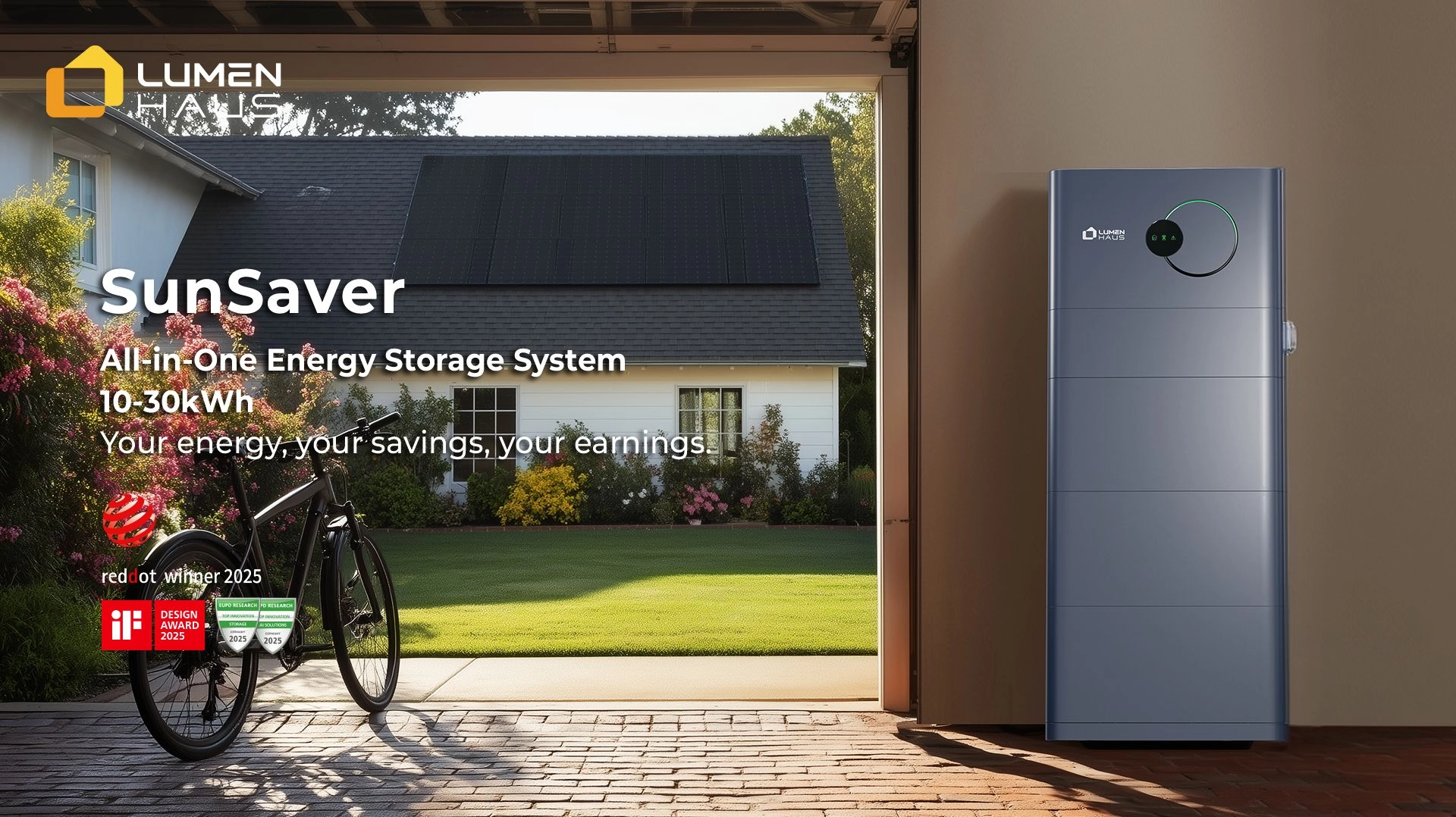
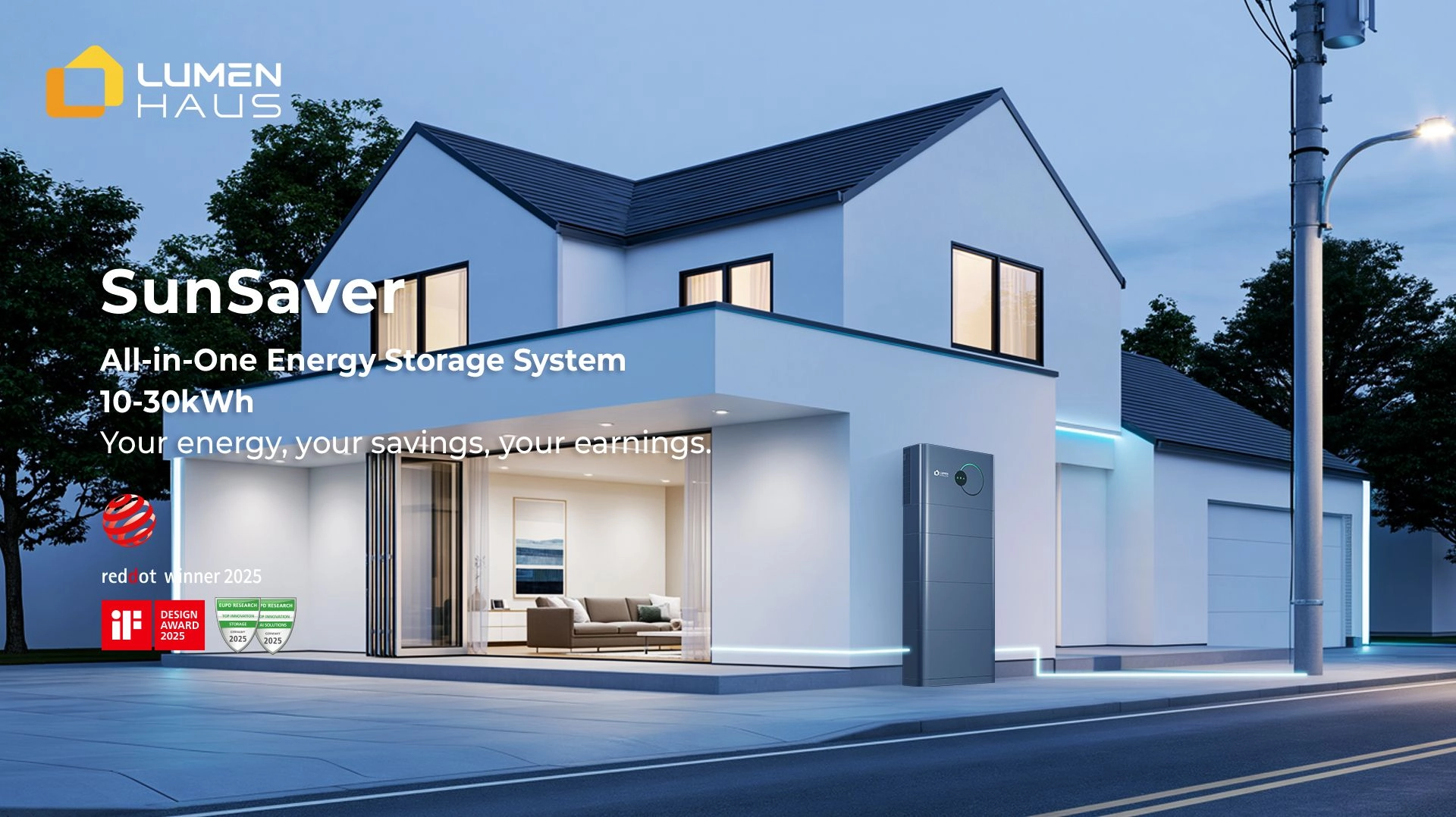
The LumenHaus SunSaver All-in-One Energy Storage System was developed specifically to address these changing requirements.
Rather than functioning as a standalone battery, SunSaver forms part of a fully integrated residential energy ecosystem. The system offers modular storage capacities ranging from 10 kWh to 30 kWh, allowing homeowners to scale storage as energy needs evolve over time.
At its core, SunSaver uses residential-grade cylindrical LFP cells engineered for up to 8,000 charge cycles, providing long-term safety, durability and performance stability.
What truly differentiates the system, however, is its Smart-Eco Mode.
Powered by AI-based optimisation, SunSaver continuously analyses household electricity consumption, solar generation forecasts, battery status and dynamic electricity pricing. Based on this information, the system automatically determines the most cost-effective charging and discharging strategy.
When electricity prices are low, the system can charge strategically. When prices increase, stored energy is prioritised. Over time, the platform learns from actual household behaviour and continuously refines its operating strategy to maximise savings and self-consumption.
For homeowners looking beyond simple battery storage, intelligent energy management increasingly plays a critical role in long-term system performance.
What Factors Influence the Price of a Battery Storage System?
Battery storage pricing in Germany is not linear. Two systems with identical capacity can differ significantly in cost depending on technical and structural factors.
The most important cost drivers are:
Battery Technology (LFP V.S. Other Chemistries)
Lithium iron phosphate (LFP) systems dominate the residential market due to higher safety, longer cycle life, and better thermal stability.
Usable V.S. Nominal Capacity
The usable energy output is more relevant than total nameplate capacity, as batteries never operate at 100% discharge depth.
Inverter Integration
Hybrid inverter systems are often more efficient but can increase upfront system cost.
Backup Power Capability
Emergency power functionality requires additional switching and safety hardware.
System Efficiency & Energy Management
Advanced EMS (Energy Management Systems) improve self-consumption but also increase system complexity.
In practice, the cheapest system is rarely the most cost-efficient over a 15-year lifecycle.
Is a Solar Battery Storage System Worth It in Germany in 2026?
For many households, the answer is increasingly yes.
Battery prices continue to decline, electricity prices remain relatively high, financing programmes remain available and federal incentives continue to support residential solar investments.
At the same time, battery storage system is no longer simply about storing electricity. It has become a central component of the modern energy home, connecting solar generation, heating, electric mobility and intelligent energy management into a single integrated system.
At LumenHaus, battery storage system is planned as part of a complete home energy strategy. By integrating solar modules, energy storage, heat pumps, EV charging solutions and intelligent energy management through the myLumenHaus App, homeowners gain a future-ready energy ecosystem designed to maximise efficiency, comfort and long-term savings.
The LumenHaus team in Düsseldorf is committed to providing transparent advice, professional site assessments and customised energy solutions tailored to each household.
Ready to take the next step?
Contact LumenHaus today and receive a personalised energy assessment, detailed savings analysis and a customised proposal designed around your home and your future energy goals.