Can Solar Panels and Home Batteries Really Bring Energy Bills Close to Zero in Germany?
In Germany, you've probably seen the ads. "Zero energy bills!" "Total energy independence!" "Solar pays for itself in no time!" And honestly, some of that is true, under the right conditions. But most homeowners end up somewhere between the glossy promise and the fine print, wondering why their experience doesn't quite match the brochure.
The actual idea of a zero-energy-bill home has become a popular reference point in marketing. In practice, these narrow conditions are: highly efficient buildings, carefully sized systems, and energy usage that is actively managed rather than left to chance. For most existing homes, solar panels and battery storage deliver meaningful cost reductions — but they do not eliminate grid dependence altogether.
Why Solar Adoption in Germany Keeps Accelerating
Residential solar growth in Germany is not being driven by a single factor. It sits at the intersection of policy support, household economics, and a structural shift in how electricity is consumed.
Electricity prices in Germany are structurally high. They were high before the energy crisis, they spiked during it, and while things have settled somewhat, there's little reason to expect a return to the cheap electricity of a decade ago.
According to a survey commissioned by BSW Solar and conducted by YouGov, around 78% of Germans support continued expansion of solar capacity. That level of consensus is unusual in the energy sector and reflects a broad recognition that household energy costs are unlikely to fall back to previous levels.
Policy frameworks reinforce this direction. KfW financing programmes continue to ease the upfront investment burden for photovoltaic systems, battery storage, and efficiency upgrades. At the same time, regional subsidies remain fragmented but relevant, particularly for households combining solar with heat pumps or EV chargers infrastructure.
The result is a market where solar adoption is no longer driven only by ideology or environmental positioning. It is increasingly driven by cost control and energy risk management.
What Actually Drives Solar Savings in a German Household
The financial performance of a solar system in Germany is rarely determined by generation alone. Two homes with identical rooftop systems can experience very different outcomes depending on when electricity is consumed and how the building behaves energetically.
Here's something that surprises a lot of new solar owners. Your panels generate most of their electricity between late morning and mid-afternoon, when most households are at their emptiest. Everyone's at work, the kids are at school, the house is just… sitting there, quietly producing electricity that nobody's using.
Household consumption tends to peak early in the morning and again in the evening. That is where the economic logic of solar begins to break down if no additional system is in place. Electricity generated at midday is either used immediately, stored, or exported. The value difference between these options has become central to residential solar economics in Germany.
The households that get the most out of solar are the ones that adapt to this reality. They schedule their dishwasher, washing machine, and water heater to run during daylight hours. Heat pumps get programmed to do their heaviest work in the afternoon. EV chargers kick in during the solar window. It takes some adjustment, but over time, it becomes second nature.
Battery Storage Changes the Shape of Consumption, Not Just the Cost
The introduction of battery storage does not increase solar generation. It changes when that generation is used.
Without storage, excess daytime electricity is pushed into the grid and later repurchased in the evening. With storage, that same electricity remains within the household energy system and is consumed later when demand rises and grid electricity is more expensive.
This shift matters most in the evening load curve, which is structurally difficult to align with solar production in Germany. Cooking, lighting, appliances, entertainment systems, heating support, and EV chargers all converge after sunset, when PV solar output is no longer available.
Battery systems smooth that mismatch across a single day cycle. They do not eliminate grid dependency across seasons, but they reduce exposure to high-price consumption windows and increase the share of self-used solar energy.
As Germany gradually expands dynamic tariffs, this function becomes more financially relevant. Under time-variable pricing, electricity cost is no longer static. It moves with wholesale market conditions and grid load. Batteries allow households to respond to those signals without manual intervention.
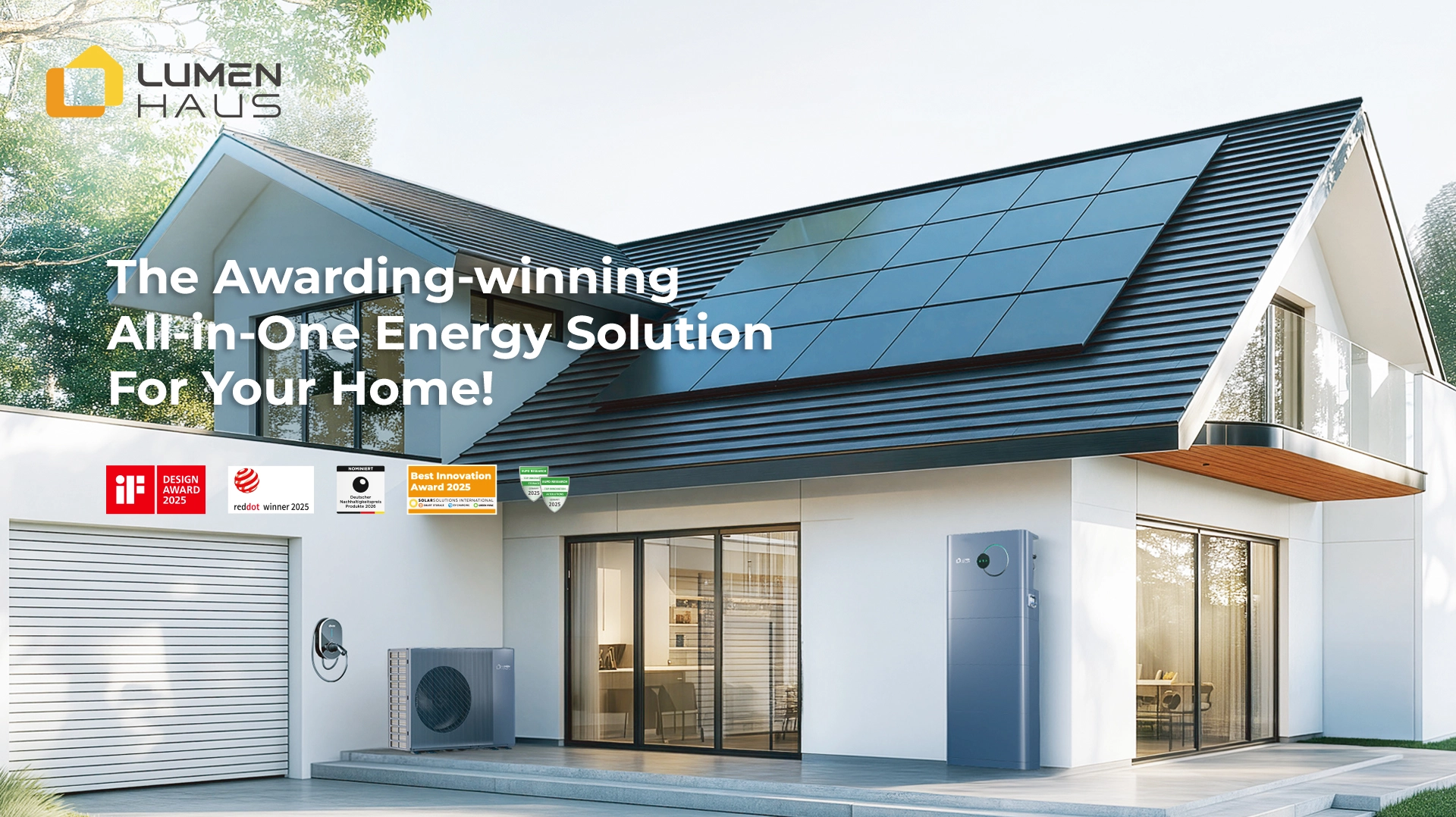
Platforms such as LumenHaus reflect a broader shift in Germany’s residential energy market toward fully integrated home energy systems. Instead of operating solar panels, battery storage, heat pumps, EV chargers, and balcony solar independently, LumenHaus connects them into one intelligent ecosystem that automatically optimizes generation, storage, charging, and consumption in real time. The real value is no longer just producing electricity, but managing when and how energy is used across the home to reduce grid dependence and improve long-term energy efficiency.
Why Winter Defines the Real Limits of Solar Self-Sufficiency
The most important constraint in German residential solar is not annual yield. It is seasonal imbalance.
German summers and German winters are, energetically speaking, almost two different worlds. In summer, long days and strong sunshine often produce more solar electricity than a household can use. Batteries fill up. Surplus gets exported. Life is good.
Winter is the flip side. Short days, low sun angles, persistent grey skies. Solar output drops significantly — sometimes dramatically. And at exactly the same time, household energy demand goes up. Heating kicks in, hot water demand rises, lighting hours increase.
Even well-sized battery systems cannot bridge this gap. Storage works on a short cycle, typically hours rather than weeks. A battery can shift midday surplus into the evening, but it cannot compensate for multiple consecutive days of weak winter production.
This is why grid connection remains a functional requirement in nearly all German residential systems, regardless of system size or configuration.
Why System Design Matters More Than Equipment Size
There is a persistent assumption that higher solar capacity automatically leads to better economic outcomes. In practice, oversized systems in inefficient homes often deliver diminishing returns.
The reason is simple. Solar panels can only offset consumption that actually exists. If a building has high heat loss or inefficient heating infrastructure, a large share of solar production is absorbed by structural inefficiency rather than reducing discretionary consumption.
This is why high-performing energy households in Germany tend to follow a layered approach rather than a single-technology strategy. Solar generation is paired with reduced consumption through insulation upgrades, efficient heating systems, and controlled energy distribution.
The interaction between these layers determines real financial performance more than installed kilowatt capacity.
Smart Energy Management Has Become the Hidden Layer of Residential Solar
As residential systems become more electrified, coordination becomes more important than generation.
Modern homes now combine solar panels, battery storage, heat pumps, EV chargers, and variable electricity tariffs. These elements do not naturally align. Without coordination, they operate as separate systems competing for electricity at different times of day.
Smart energy management software increasingly resolves this mismatch by aligning production, storage, and consumption automatically. Instead of optimizing each device individually, the system optimizes the household as a whole.
Platforms such as the myLumenHaus App reflect this shift. Energy decisions that were previously manual—when to charge a battery, when to run appliances, when to prioritize heating—are increasingly handled through automated control logic based on real-time production and pricing data.
Smart control modes such as optimized charging, adaptive heating schedules, and self-consumption prioritization are no longer optional add-ons — they are becoming the operational backbone of modern residential energy systems. With intelligent features like Smart-Eco, Smart-Charging, and Smart-Heating, myLumenHaus automatically optimizes household energy usage to reduce electricity costs with minimal user intervention. When combined with dynamic electricity tariffs, these AI-driven smart modes can intelligently shift energy consumption to the most cost-efficient periods, helping homeowners maximize self-consumption, lower grid dependency, and unlock even greater long-term energy savings.
Are Solar Panels and Home Batteries Worth It in Germany Today?
For most homeowners, the answer remains yes.
In financial terms, solar panels and battery storage remain one of the most effective ways to reduce long-term household electricity costs in Germany. They do not eliminate energy bills, but they change their structure.
Instead of unpredictable monthly exposure to grid pricing, households move toward partial self-generation, partial storage, and reduced dependence on peak electricity markets.
The strongest results are not achieved by maximizing system size, but by aligning four factors: building efficiency, solar generation, storage capacity, and consumption behavior.
Where those four elements are coordinated, residential energy systems in Germany move closer to stability, even if complete independence remains out of reach for most homes.
Want to find out if solar and batteries are right for your home? Complete LumenHaus online form for a free, no-obligation evaluation.