How to Choose a Balcony Solar Battery Storage System in Germany
Your balcony solar panels are probably doing their best work while you’re out. By the time you’re back home, cooking dinner and switching on the lights, solar generation is already winding down for the day. A balcony solar battery storage system captures some of that daytime surplus and holds it for later — so more of the electricity your panels generate actually ends up being used by you.
But which battery storage system should you choose?
The right balcony solar battery storage system matches your available solar surplus, evening electricity use and installation conditions, with clear evidence of safety, durability and support. Capacity matters, but so do the controls that manage it and the options available when your needs change.
For households considering LumenHaus SunMini, the following checks provide a practical starting point.
Start with your household electricity use
Before comparing batteries, take a closer look at when your household actually generates and consumes electricity. Annual consumption figures alone won’t tell you how much storage you need, and they’re one of the more common places people trip up early in the process.
The useful questions are more specific: how much solar electricity is left over after daytime use? How much grid electricity are you buying in the evening? And how do those patterns shift across the seasons? Monitoring data from your existing solar system or electricity meter can help you build a realistic picture.
Choose capacity you can regularly charge and use. If little solar energy is left over, a larger battery may spend much of its time partly empty. If substantial surplus is available and evening demand is high, additional storage may be useful.
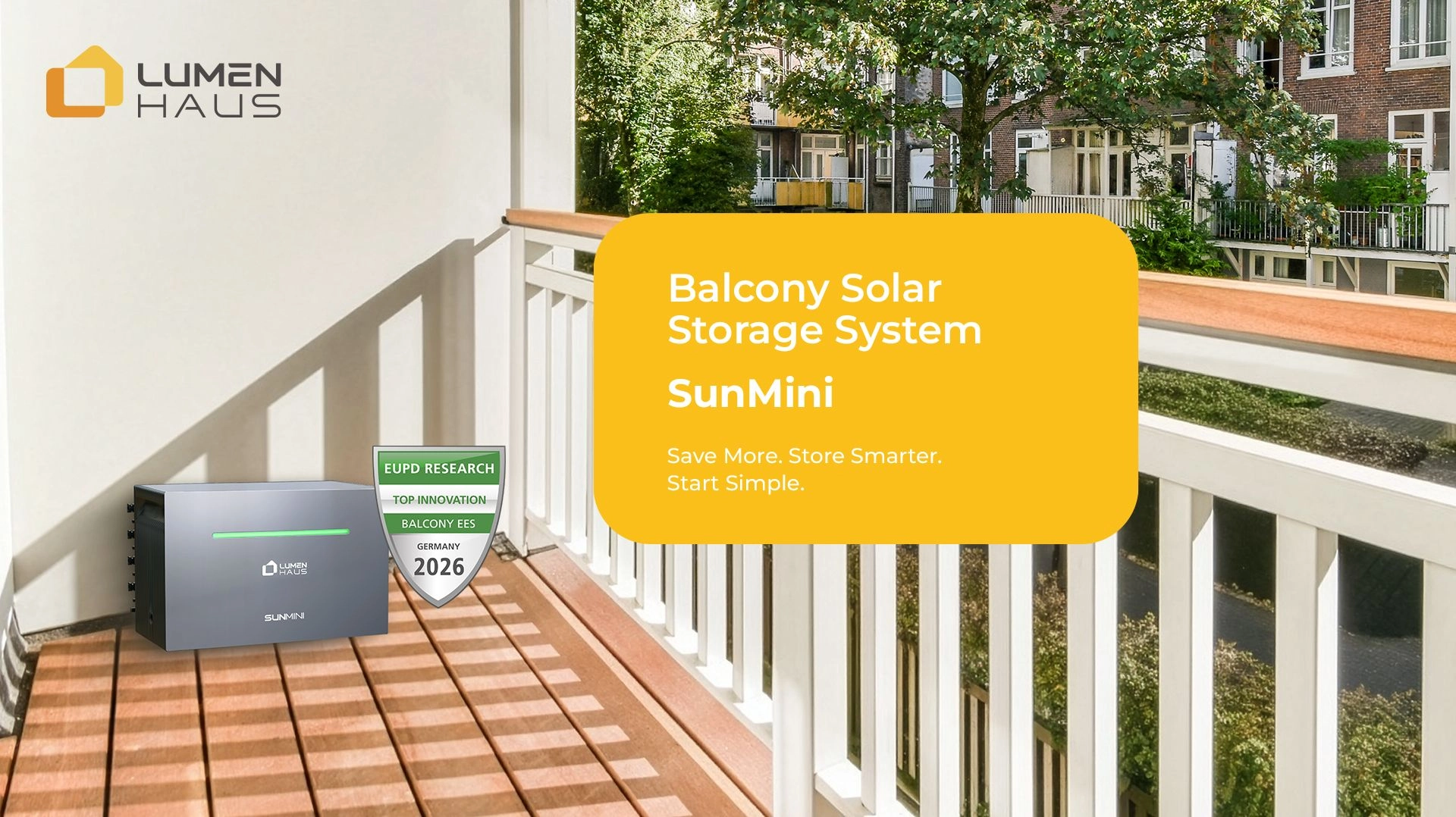
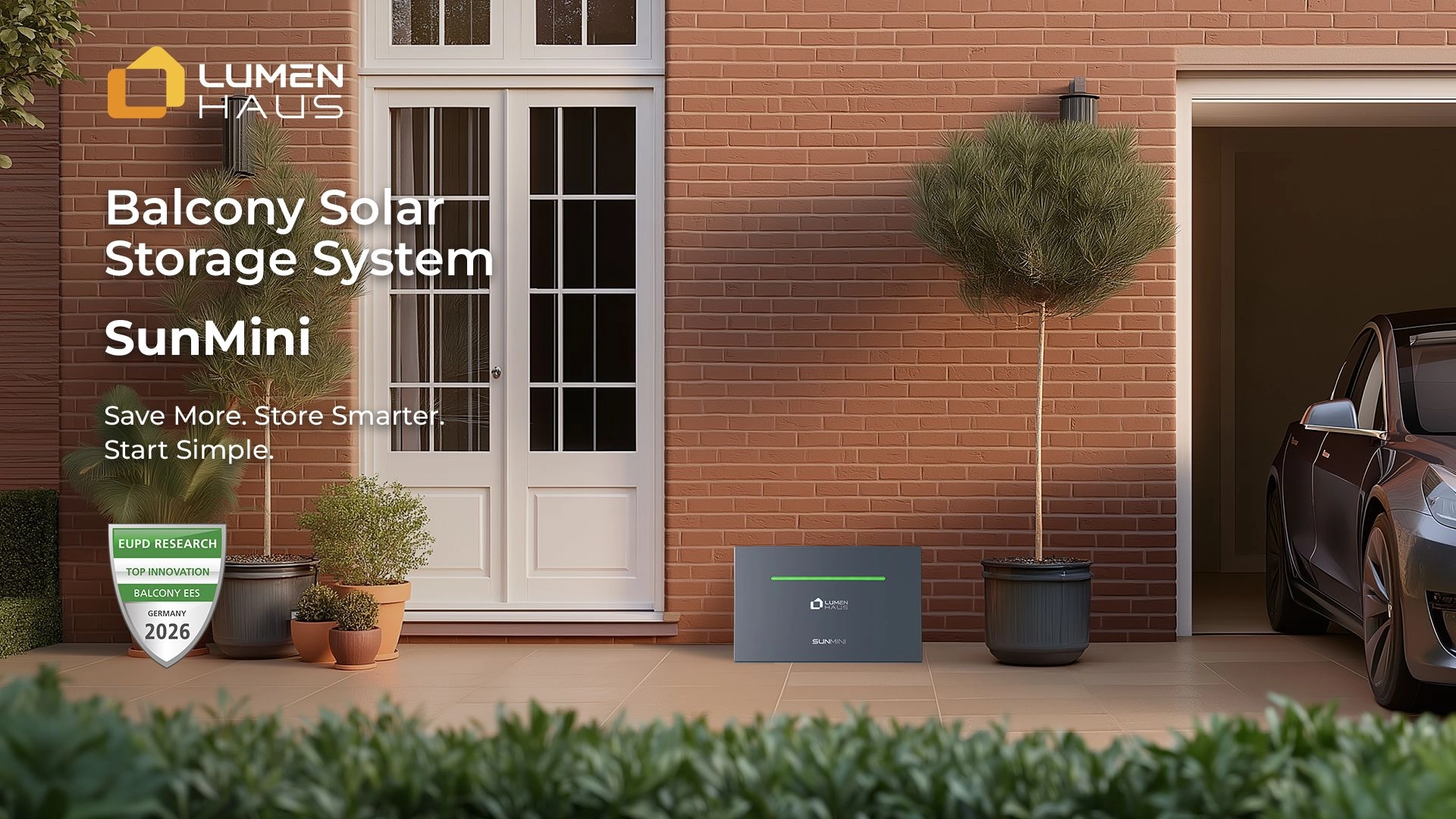
SunMini balcony solar sotrage system starts with approximately 4 kWh of nominal battery capacity and supports modular expansion. That offers flexibility to add compatible capacity later, after understanding your actual usage.
Remember the distinction: kWh describes stored energy; kW describes power. More battery capacity does not automatically increase the output available to run appliances.
Seven quality checks before buying a balcony solar battery storage system
A good supplier should make it straightforward to understand what you are buying. Use these questions when comparing offers.
1. Battery transparency
What cell chemistry is used, and what cell specifications and traceability information are available?
2. Usable capacity and cycle life
How much energy can I use, and under what conditions was the cycle-life figure measured?
3. Safety protection
What safety documentation covers this model, and how does its battery management system protect the cells?
4. Installation environment
What are the charging, discharging, weather-protection and ventilation requirements?
5. Expansion compatibility
Which modules can I add later, and will I need extra equipment or installation work?
6. Customer support
Is German-language support available, and what happens after I report a fault?
7. Software support
How are updates delivered, and which functions remain available without an internet connection?
Ask for the current datasheet, installation manual and warranty alongside the quotation. These documents make it easier to compare both the equipment and the support behind it.
Compare battery life and warranty coverage carefully
Cycle life describes how a battery performs under specified test conditions. Temperature, charging rate, depth of discharge, and the remaining-capacity threshold used as the endpoint all influence how a cycle-life figure should be read, and whether two products’ figures are genuinely comparable.
SunMini uses lithium iron phosphate, or LiFePO4, battery chemistry. Its datasheet specifies 10,000 cycles at 25°C ±2°C. When comparing products, check that their figures use comparable test conditions.
A battery's depth of discharge describes how much capacity can be used during discharge. It does not describe its conversion efficiency or promise that its original capacity will remain unchanged throughout its life.
SunMini also comes with a 10-year warranty, subject to the applicable terms. For any battery, look beyond the warranty period: retained-capacity commitments, throughput limits and exclusions determine what the warranty means in practice.
Choose a system that works with your balcony
Balconies rarely offer identical conditions. Panels may face different directions, receive sunlight at different times of day, or deal with partial shade from neighbouring buildings or structures. How a system manages those varying inputs can matter just as much as its headline solar input rating.
SunMini’s 4 MPPT channels allow compatible solar inputs to be tracked separately — giving households more flexibility when panels can’t all share the same orientation. It doesn’t eliminate the effects of shading, but it does help the system manage genuinely different generation conditions across multiple panels.
Placement matters too. SunMini combines an IP65 enclosure with natural convection cooling, supporting practical installation close to the home. Follow the installation manual for positioning, ventilation, and weather exposure.
For winter use, check the permitted charging temperature and cold-weather protection.
Make stored energy easier to manage
A useful battery should fit your routine. On a sunny weekday, that may mean storing electricity while you are at work and using it later for lighting, entertainment and other household loads.
SunMini's Smart-Eco Mode uses electricity prices, solar generation and household consumption to inform charging and discharging decisions. The aim is to make better use of available energy with less manual scheduling.
With an appropriate dynamic tariff and system configuration, the battery can also charge during lower-price periods and supply electricity when prices are higher. LumenHaus Dynamic+, developed with naturstrom, brings dynamic electricity pricing into the LumenHaus energy offering. Quarter-hourly billing requires a suitable smart meter.
The financial benefit depends on the complete tariff, household demand and the price difference after storage losses. An app should help you understand those energy flows, as well as change settings. The myLumenHaus App gives users a central interface for monitoring and managing supported devices.
Check the German installation requirements
In Germany, a balcony solar storage system is commonly called a Balkonkraftwerk. Its battery capacity, solar input capability, grid-connected output and backup output describe different things.
The Bundesnetzagentur sets out limits of 2,000 W of connected PV module capacity and 800 VA of inverter power for the EEG's special plug-in-solar provisions. Its guidance considers the highest selectable inverter output, rather than a temporarily reduced setting.
Confirm the connection method, registration requirements and permitted configuration for the exact system you intend to install. A higher hardware or backup rating should not be treated as the permitted output through a household socket.
A route into the wider LumenHaus energy ecosystem
SunMini is part of LumenHaus's integrated home energy portfolio, which brings together solar generation, battery storage, heating and EV charging. The range also includes SunCatcher solar panels, SunSaver home energy storage system, SunHeater heat pumps and SunCharger EV chargers.
The myLumenHaus App provides a shared interface across compatible products, with Lumi offering AI assistance. For households starting with balcony solar, this creates a route towards broader energy management as their home and equipment evolve.
SunMini also received the EUPD Top Innovation Award 2026 in the balcony energy storage category for Germany.
Frequently asked questions
Is a balcony solar battery storage system useful if I am out during the day
It can be particularly useful when your panels produce surplus electricity while you are away and you need that electricity later. Whether it is worthwhile depends on your generation, consumption pattern, usable storage capacity and total system cost.
Can I add battery capacity when my electricity use increases
Yes, if the system supports compatible expansion modules. SunMini offers modular expansion, allowing storage capacity to develop with your needs. A future heat pump or EV still requires a separate assessment of power demand, solar generation and the overall system design.
Will a balcony battery keep my whole home running during a power cut
Whole-home backup should not be assumed. SunMini has a designated off-grid AC output rated at up to 2,500 W for suitable connected loads. The appliances it can supply and their runtime depend on output limits, starting demand and available battery charge.
Find the right SunMini setup for your home
Choosing well starts with understanding your home, then finding a battery that fits. SunMini combines modular storage, flexible solar inputs and intelligent energy management to help you make more use of the electricity available to your household.
Explore LumenHaus SunMini to see how the system works and discover its features.
Need help choosing a configuration? Talk to LumenHaus about your SunMini setup. Share your location, existing solar setup and typical electricity use to start the conversation.