Solar Battery Storage in Germany 2026: A Complete Guide to Choosing the Right System for Your Home
Solar Battery Storage in Germany 2026: Costs, Savings & Is It Worth It?
Germany’s residential energy landscape has undergone a fundamental transformation. By 2026, installing solar panels alone is no longer enough to deliver meaningful cost savings or long-term energy security. For homeowners, the focus has shifted from simply generating electricity to efficiently storing and managing solar energy in order to protect against volatile electricity prices and an increasingly strained power grid. For German homeowners, the key question in 2026 is no longer whether to install solar — but how to store and use it efficiently.
This is why home solar battery storage has become a core component of modern household energy planning. In Germany, battery systems have evolved from simple backup solutions into active energy management tools. They have evolved into strategic tools for maximising self-consumption, reducing electricity costs, and increasing independence from the grid. With dynamic electricity tariffs becoming more common, feed-in remuneration remaining low, and electricity demand rising due to heat pumps and electric vehicles, battery storage now sits at the heart of a future-ready home energy system.
Why Solar Battery Storage Matters More Than Ever in Germany in 2026
The German solar market clearly reflects this shift. Today, most new photovoltaic systems are planned together with battery storage, while demand for retrofitting batteries to existing PV installations continues to grow steadily. Homeowners are increasingly prioritising predictability and control over maximising feed-in revenue.
In a market characterised by sharp electricity price fluctuations and policy frameworks that favour self-consumption, solar battery storage is no longer a “nice-to-have” feature. For many households, it has become a rational economic decision. At the same time, concerns about grid reliability are growing. Even brief power interruptions can disrupt home offices, heating systems, internet connectivity, and other essential household functions.
A well-designed battery storage system provides automatic protection for critical loads, without requiring manual intervention. By increasing on-site solar consumption, it also reduces dependence on fossil-based electricity generation, directly supporting Germany’s broader energy transition.
Are Solar Battery Storage Systems Worth It in Germany? Cost, Payback and Real Returns
Yes — solar battery storage systems can be financially worthwhile in Germany, but returns depend heavily on system sizing, household consumption, and future electricity demand. Whether a home solar battery storage system is financially worthwhile in Germany depends largely on how well it is matched to a household’s electricity consumption profile. There is no universal answer. In practice, payback periods for combined solar and battery systems typically range from around seven to nineteen years, depending on system size, usage patterns, and future electricity demand.
Households with relatively low annual electricity consumption — around 3,000 kWh per year — tend to experience longer payback periods. In these cases, a large share of solar electricity is exported to the grid and compensated at comparatively low feed-in tariffs. While such systems still offer environmental benefits and a degree of energy security, their financial returns are generally more limited.
The strongest economic performance is consistently seen in households with higher electricity demand. Systems combining approximately 15 to 19 kWp of photovoltaic capacity with 15 to 20 kWh of battery storage, paired with annual consumption levels between 9,000 and 12,000 kWh, typically deliver the most attractive results. Under these conditions, payback periods of seven to eight years are realistic, with total lifetime returns often exceeding 200 percent.
As electricity demand increases — particularly through electric vehicles and heat pumps — the share of self-consumed solar energy rises. This directly reduces grid imports and improves overall system efficiency.
Several factors play a decisive role in return on investment. Larger photovoltaic systems increase total energy generation and self-sufficiency, while adequate battery capacity adds flexibility and resilience. Higher household consumption generally shortens payback periods by improving the alignment between energy production and usage.
By contrast, systems that export a large proportion of solar electricity to the grid tend to generate lower returns, as the gap between retail electricity prices and feed-in remuneration remains substantial. In simple terms, the better the match between solar generation, battery capacity, and household consumption, the stronger the economic outcome.
What a Home Battery Can Really Do for German Households
Beyond financial performance, solar battery systems offer practical benefits that are increasingly valued by German homeowners. By shifting electricity usage away from high-price tariff periods, batteries help stabilise energy costs throughout the year. During grid outages, they ensure uninterrupted power for essential appliances such as refrigerators, routers, heating controls, and medical equipment.
For households working from home or relying heavily on digital services, this level of resilience is no longer a luxury — it is becoming a necessity. From an environmental perspective, maximising self-consumption of solar energy reduces reliance on grid electricity and lowers overall carbon emissions, further enhancing the sustainability benefits of photovoltaic systems.
How to Choose the Right Home Solar Battery System in 2026
Choosing the right solar battery system in 2026 requires aligning technical design with household behaviour and future energy needs. Selecting the right solar battery system starts with a clear understanding of household priorities. Homeowners should determine whether their primary goal is lowering electricity bills, securing backup power, increasing energy independence, or preparing for future electrification.
A realistic assessment of current and future electricity consumption is essential, particularly for households planning to add electric vehicles, heat pumps, or additional occupants. Flexibility and scalability should therefore be key considerations when evaluating system options.
Before making a final decision, it is advisable to review at least twelve months of electricity bills to identify peak and off-peak usage patterns. Quotes from experienced installers should provide transparent pricing for battery capacity, installation costs, available incentives, and long-term service or maintenance.
Payback calculations should be based on realistic savings assumptions, while also accounting for the added value of resilience, energy security, and comfort. Selecting a system that allows for future expansion can help homeowners avoid unnecessary and costly upgrades later on.
The Best Solar Battery Systems in 2026: Why Intelligence Matters
As the market matures, intelligent energy management has become a decisive factor in system performance. Modern battery systems are no longer passive storage units; they actively manage energy flows in response to price signals, consumption behaviour, and generation patterns.
Systems that integrate advanced software and adaptive control consistently outperform those relying on fixed charging and discharging schedules. Over time, intelligent optimisation can significantly increase self-consumption and reduce grid electricity costs.
Why LumenHaus SunSaver Is Designed for German Homes
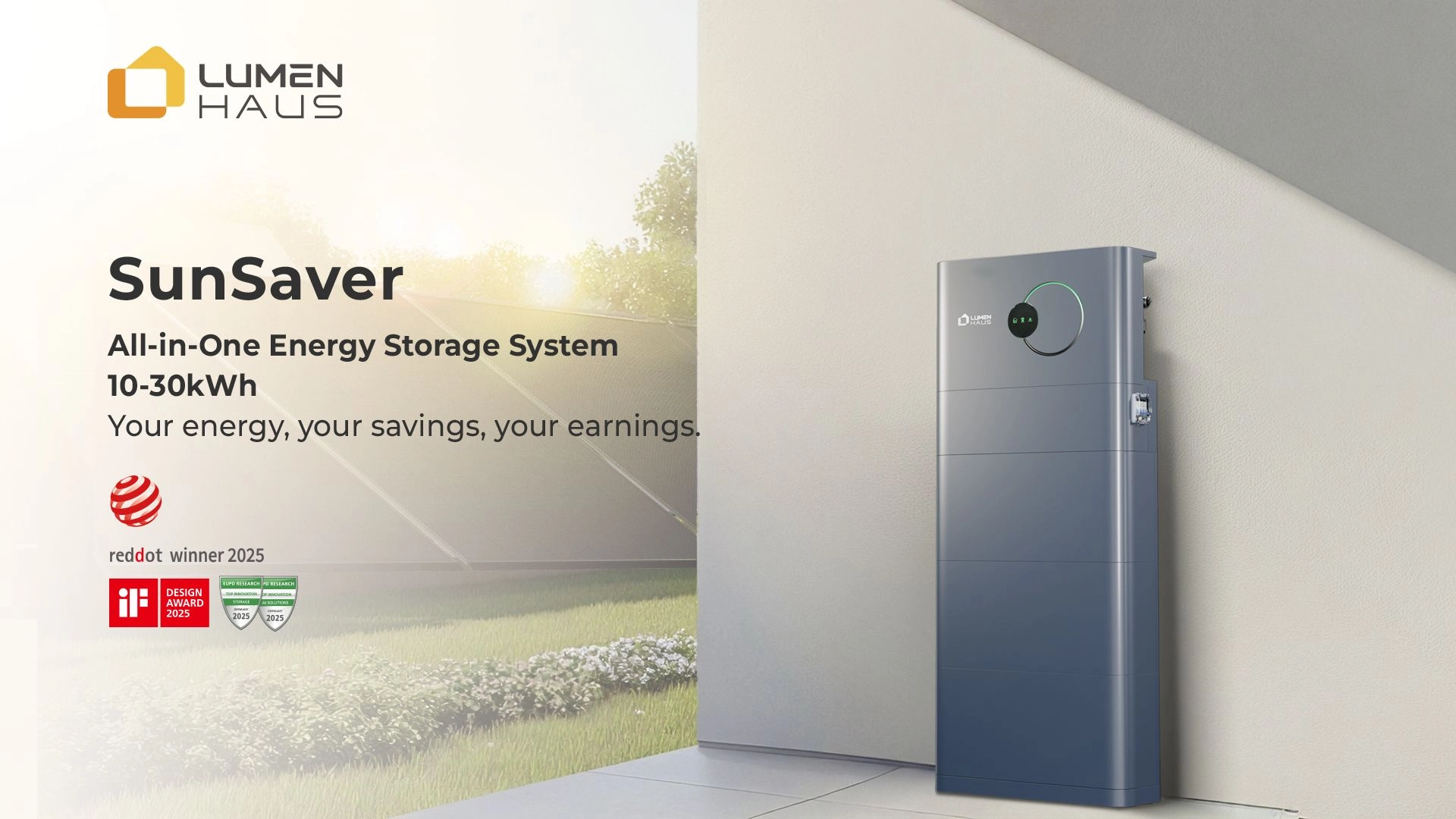
The LumenHaus SunSaver All-in-One Energy Storage System represents a new generation of intelligent residential energy systems. Designed specifically for German households, SunSaver combines a highly integrated, space-efficient architecture with modular scalability from 10 to 30 kWh, allowing capacity to grow alongside evolving energy needs.
Its residential-grade cylindrical cells provide long-term reliability with up to 8,000 charge cycles, delivering long-term durability and performance stability over many years of daily operation. What truly differentiates SunSaver, however, is its Smart-Eco Mode.
Powered by AI-based learning, the system continuously analyses household electricity consumption, photovoltaic output, battery status, and dynamic electricity prices. Based on this data, SunSaver automatically charges during low-price periods, prioritises stored or solar energy when prices rise, and refines its strategy over time as it learns from real-world usage.
Under favourable conditions, this intelligent optimisation can reduce grid electricity costs by more than 96% (based on real user data from June 2025) — positioning SunSaver among the most advanced residential energy storage systems on the German market.
Beyond performance, SunSaver’s clean and understated design integrates seamlessly into modern living spaces. Its intuitive interface and clear status display make system operation transparent and accessible for all household members, reflecting LumenHaus’ commitment to combining technology, usability, and aesthetics.
Conclusion: Building a Future-Proof Home Energy System
In 2026, investing in a home solar battery system in Germany is no longer about adding another component to a photovoltaic installation. It is about creating a smarter, more resilient energy infrastructure that adapts to fluctuating electricity prices, changing household needs, and a rapidly evolving energy market. When photovoltaic capacity, storage size, and consumption are properly aligned, a home solar battery system delivers strong financial returns, greater independence, and long-term security — making it a compelling investment for an increasing number of German households.
Take the next step towards energy independence with LumenHaus SunSaver.